Sunday, May 25, 2008

cmd key confusion


When I picked up an old 12" PowerBook G4 last fall (just in time for the launch of Leopard!) I wondered how long it would take to become familiar enough with keyboard shortcuts under OS X such that they'd become reflex actions. Not long at all, as it turns out - especially once I worked out that the Command key on a Mac is similar in concept to the Windows key on a PC.

After several months of switching between Windows PC (at work) and a Mac (at home), I find the daily transition fairly seamless - with one exception. I use keyboard shortcuts fairly often when browsing, especially to jump to the browser Search and Address fields. Jumping to the Address field in Safari is Cmd-L, so after an evening of web surfing I find the first thing I do the next day at work on my Windows PC is hit the Windows-L key combination - which logs me out. It's been months now, and I still do this every two or three days! Argh!

Sunday, May 18, 2008

ted, this case is closed

I've been excited about receiving a TED 1001 home energy meters for two weeks now. I downloaded and skimmed through the TED manual to see what the installation requirements were. I Googled online forums to learn how I might connect the TED display unit to my home Linux server and archive energy data. On Thursday, I received a new TED on loan that I could use for the energy efficiency experiment I had in mind. Even better - with the Victoria Day long weekend, I figured I had plenty of time to install the metering unit and test out communications over the power lines to the display unit.

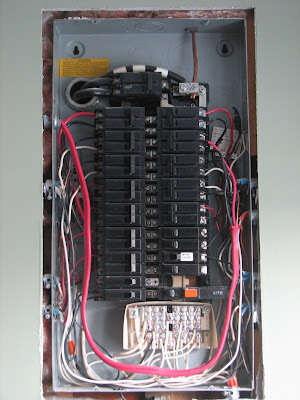
Then I opened my electrical panel and found this:


The main service conductors come into the panel from the top left, just below the yellow sticker. These bad boys are thick and sturdy, and placed far too close together for me to get the CTs clamped on. Better yet, I can't de-energize these cables in order to feed them through the CTs - that would have to be done on the BC Hydro side of the circuit.

So that's it - the monitoring experiment case is closed. BC Hydro does offer reasonable historical billing data, however, so I may still grab coincident weather data and run a quick model to check the efficiency of my home. The TED will be passed on to some lucky colleague at work to play with - I hope their electrical panel is easier to work with than mine!

Friday, May 09, 2008

email purgatory

As mentioned in a previous post, I'm a fan of desktop search engines like Google Desktop. With files at home and at work numbering in the tens of thousands, I can't imagine any other way of quickly finding what I'm looking for. I often still organize files into directories by project or category, but also often find that even if I remember exactly which folder I've placed a file in, it's faster to retrieve it via search rather than drill down five folders to get it.

I used to have rich hierarchies of folders for storing work email messages, but now I rely primarily on just two - Keepers and Purgatory. The vast majority of messages I receive at work are either (a) messages I can scan and delete immediately, (b) messages I wish to keep for reference forever, or (c) messages I wish to keep for reference but which have a limited "shelf life". The realization that this third "Purgatory" category exists has helped me prune down my inbox tremendously. I found that I wanted to keep many messages with information that was useful over a span of weeks or months, but that after that period, the information was "stale" and no longer needed. I now drop such messages into the Purgatory folder, which has a simple Outlook archive rule - delete all messages older than 6 months. This sliding 6-month window lets me keep messages while they are useful and prunes out those that are not.

A final note - a number of new tools are arriving to help people organize and find their email, one of which is Xobni, an extension for Outlook which uses social connections gleaned from your email to help you find messages and information about contacts. The Xobni Insight extension beta recently went public, but I had a chance to participate in the private beta a few months ago. My verdict? Although the organization by social context was cool and the email stats were spiffy, I still found my self gravitating towards Google Desktop to find messages. If I wanted to find a recent message from Joe, I found it faster to hit CTRL-CTRL to bring up the Google Desktop search box and type "from joe" rather than find the contact in the Xobni sidebar in Outlook.


Sunday, May 04, 2008

franken-coder

My first computer (everyone has impossibly fond memories of their first computer, don't they?) was a Radio Shack Colour Computer. With 16k of RAM. For the kids out there, that's not a typo - I'm talkin' 16 kilo-bytes of space to drop code into. Friends helped me double that to 32k by piggy-back soldering additional DIP-style RAM chips on top (except the address/strobe pin - that we bent and connected to some address/strobe line on motherboard). Yup - those were the days...

The reason I wanted a computer in the first place was so that I could code - I'd been fascinated with the concept of creating my own programs ever since buying a book on programming in Basic and reading it cover-to-cover the year before. I messed around with several little programs from that book (like Hunt the Wumpus) but the program I was most proud of creating was a Tron-style light cycles game for two players. I remember it taking forever to get several timing delays just right!

I never really coded much after leaving high school. Sure, there were Fortran and Pascal and other courses that were part of the standard engineering program, but those courses were never fun in the way coding the Tron light cycles game was. Assigned projects were just that - assigned by someone else, to write a program that didn't "scratch an itch" that I had myself.

The release of Google App Engine has sparked my interest in programming again, especially a style that I'll call franken-coding. I expect many see cloud platforms such as GAE as low-cost ways to host the comprehensive applications that they wish to write and deploy. I'm more interested in the new kinds of mini-applications that will be enabled by the zero-cost approach taken by GAE. Think Unix-style tools, but for the cloud - the equivalent of grep, cat, etc, but for web applications. While some folks may draw satisfaction writing everything from scratch, I'm quite happy to stitch together such mini-applications to accomplish a task.

I'm tempted to make my first GAE application a Tron light cycles game...

Saturday, April 12, 2008

embedded google app engine

Sometimes I get the craziest ideas whilst talking an hour-long walk by my lonesome. Here's one of them.

The recent launch of Google App Engine has all a-twitter about the possibilities offered by cloud computing - especially when the starting cost is zero. I heard the news the day after GAE launched, which means I was half a day late in trying to get one of the 10,000 accounts open during the initial beta release. I did notice, however, that anyone could download the GAE SDK, which, as one of the GAE help pages says:

...includes a web server application that simulates the App Engine environment, including a local version of the datastore, Google Accounts, and the ability to fetch URLs and send email directly from your computer using the App Engine APIs.

The SDK runs on any computer with Python 2.5 and comes packaged for Windows, Mac OS X and Linux.

These facts were tumbling in my mind during my walk when I switched to thinking about embedded device projects I'd like to work on sometime. I switched to Tomato firmware on my Linksys WRT54G router some time ago, and I've been interested in turning a Linksys NSLU2 (aka "the slug") into a Linux box for dedicated applications (web server, iTunes shared library, etc).

Then the statement above from the GAE help page popped into my head: "The SDK runs on any computer with Python 2.5...". Wait, WHAT? A few quick Google searches later confirmed what I expected: several Linux distros for embedded devices have optional Python 2.5 packages. Another quick check shows that the GAE SDK is less than 3MB in size.

Question: does this mean I can essentially run the GAE development environment on an embedded device? And if so, what the heck would you use that for? I'm not sure yet, but it would be fun to be one of the first to run GAE applications on my router...

Monday, March 31, 2008

the other 13%

I wonder how many households in Canada have access to cable and/or satellite TV, and how many depend on over-the-air programming? Ten years ago such questions may have popped into my head and gone unanswered, but now the answer is 5 minutes away via Google.

The title of this CRTC report, "How Many Canadians Subscribe to Cable TV or Satellite TV", is exactly what I was looking for. Both Nielsen Media and StatsCan numbers are remarkably similar - something like 87% of Canadians subscribe to cable or satellite TV. The other 13% get whatever scraps are broadcast over the air.

I'm now one of the other 13%.

I had reduced my subscription to Basic cable some time ago because I found I wasn't watching any of the premium channels in the more expensive subscription packages. Today I cancelled Basic cable because I can't even remember the last time anyone in the family watched anything on any cable channel.

I haven't dropped Shaw entirely, though - they still provide me with my precious Internet link. The only way I'll be giving that up is when someone pries it from my cold, dead fingers.

Saturday, March 15, 2008

tasty google bookmarks

I opened a del.icio.us account as soon as I read about it, and posted my first bookmark on November 4, 2004 - an overview of 10 alternatives to the recently-killed bittorrent search engine Suprnova, as it turns out. Since that time I've continued to post my bookmarks to del.icio.us, amassing a total of 900+ to date.

I was posting a new bookmark recently when it suddenly struck me: I couldn't remember when I had last used del.icio.us to retrieve a bookmark. In fact, I view my friends' shared bookmarks on del.icio.us (via RSS) far more often than my own!

I find that I've adopted a search frame of mind for information retrieval - and not just for new material. Having used Google Desktop for several years now, I tap CTRL-CTRL instinctively to search for and retrieve documents even when I know exactly where they are. And I've increasingly used the same approach for web sites that I've bookmarked - Google search is so fast that I can jump to a well-known site more quickly than I can type the URL! There are, however, some gems in the 900+ bookmarks I've collected in del.icio.us that I've forgotten about. Many times I've "rediscovered" sites when I attempt to bookmark an interesting web site I've found, only to discover that I had already bookmarked it in the past! But I find I can't break the Google search habit I've developed, even when a quick search of del.icio.us might turn up exactly what I'm looking for.

Enter Google Bookmarks. I had given this new Google feature a try when it was first released, but found it didn't have several key features (like tagging) that made del.icio.us so valuable to me. Google Bookmarks has since added tagging, but otherwise had no additional "killer" feature to tempt me to switch. Until I read this snippet on a blog, that is.

The most important features that set Google Bookmark apart from other services is that all your bookmarks are private (nobody else can see them) and fully searchable. You are no longer restricted to the title of the page, the description and the URL - you can search the entire page.

Whoa - hang on. GB indexes all the text on all pages I bookmark and makes it all searchable? After some testing, I also found that GB bookmarks are included (and highlighted) in Google searches (when I'm signed in) and in results-as-you-type in the Firefox search box. I was hooked.

I've since switched to GB for all of my bookmarks, and now I see them pop up all the time when I'm searching for stuff using Google. Both the bookmarklet and Google Toolbar tools for bookmarking support tags and auto-suggest tags when you bookmark a page, but not at elegantly as del.icio.us does [sigh]. There's no doubt, though, that I get more out of my bookmarks now that they're woven into my "search reflex" approach to finding information.

Saturday, January 12, 2008

my social outlook

Email has oft times been called the "killer app" that drove exponential growth of the Internet, but I'm fascinated by how little my "email experience" has changed over the last 10+ years. My workflow for writing and reading email in Outlook 2003 at work is little different than the workflow I followed when I first started using email on bulletin boards in high school! The last major change in the way I handle email came when I switched over to Gmail for all non-work email two years ago - I now use tagging and search to manage email. In fact, Google Desktop has done more to change my work email habits than anything in the Outlook client - I use just a few folders to hold all email and simply search to find what I'm looking for.

Xobni Insight piqued my interest when I read about it in this Lifehacker posting earlier today. I've read postings in the past about attempts to apply a social network approach to organizing and presenting email, but this is the best realization of that concept I've seen to date. Xobni Insight is currently in limited beta for Outlook 2003/2007 - I've signed up and I'm anxiously awaiting an invitation to give it a try. I'll follow up with a posting about my experiences with Insight once I have it up and running.

Thursday, September 27, 2007

my internet tv


Several pieces to a puzzle I didn't know I was trying to solve have suddenly come together, and I'm only spending enough time to post this minimal update so that I can get back to finishing this project.

The first piece is Miro (formerly the Democracy TV project), a lovely media player that merges the play-anything smarts of VLC with the ability to slurp content from RSS feeds that use for content. When combined with a built-in BitTorrent engine, it's enough to send even the most seasoned TV studio executive to the liquor cabinet.

As one might expect, there are several sources of RSS feeds for popular (and not so popular) TV shows. The excellent tvRSS even allows you to tweak your feed so that, for example, it only contains HDTV-ripped shows. Now that's thoughtful! But a Miro "channel" created with such a feed is stark in comparison to several channels that come with the default Miro installation. Where was my show description, episode title and synopsis? Where were my video still thumbnails?

I knew several web sites offered this kind of information, but I wanted a site that offered it in a structured format - preferable, as an RSS feed. It took a while to find, but theTVdb provides all of this, and more. This site is used by several home theatre PC projects to provide metadata for TV shows captured.

But there was still one piece missing: how could I combine the TV torrent feed with the TV metadata feed to get one feed that Miro could use? I contemplated cracking open documentation pages for bash, PHP and Python to roll my own script when I remembered Yahoo Pipes. This Yahoo project is designed to slurp in structured content like RSS feeds and provides tools for manipulating the data to create new feeds! Sounds just like what I'm looking for.

Stay tuned for future postings about my antics with Yahoo Pipes...

Tuesday, September 18, 2007

the times is a-changin'

A sign of things to come: the New York Times has decided to stop charging for the few remaining sections of its online publication that have been available by subscription only. The reason? I can't state it better than this senior VP:

The Times said the project had met expectations, drawing 227,000 paying subscribers — out of 787,000 over all — and generating about $10 million a year in revenue.

“But our projections for growth on that paid subscriber base were low, compared to the growth of online advertising,” said Vivian L. Schiller, senior vice president and general manager of the site, NYTimes.com.


In other words, they can make more money by attracting as many eyeballs as possible to their content (with ads) than they can by charging a subscription. Seems like advertising is being leveraged to support everything these days; I wonder what the limit is?

NYT story link (available for free, naturally).

Wednesday, August 15, 2007

LOLcat meets Dune

Ok, it's now official: the whole LOLcat meme is out of control.


Monday, July 30, 2007

Wednesday, July 04, 2007

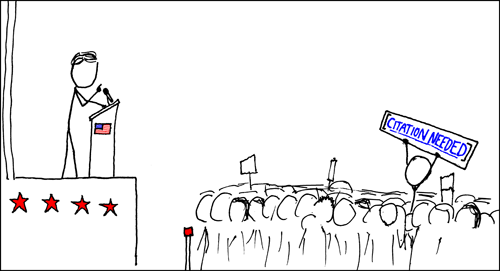
wikipedian protester

Great new cartoon posted at xkcd.

Wikipedian Protester

Sunday, July 01, 2007

checking out bytes


It's always interesting to see old distribution models applied to new media, and especially humourous when those models enforce constraints that simply don't apply to bytes. So I had a chuckle when I learned about the OverDrive distribution system being used by the BC Libraries to offer audio books to patrons.

I was pleased to hear that our library system now offered audio books as a direct download (yay!) and disappointed (but not surprised) to learn that DRM was involved (boo!). The chuckle came, however, when I read this snippet from the BC Libraries web site:

"You may have a maximum of 5 titles checked out from the Digital Library.
Downloaded titles are checked out for 14 days and are automatically returned to the library."

"Checked out"? "Returned"? What, do the bytes magically travel back from my computer or MP3 player to their home servers [giggle]? Such restrictions make sense in a world where you are actually borrowing a book or physical media; as long as you have the atoms in your hand, no one else can use them. But downloaded bytes?

I doubt, of course, that our library system lobbied for these restrictions - such concessions were likely by the publishers as a key condition to making them available through the library system at all. But when the gap between the fluid availability of bytes and centuries-old distribution model designed for physical objects becomes so glaringly obvious, it's only a matter of time before someone takes advantage of this inefficiency.

Friday, April 06, 2007

foxy del.icio.us


In a posting on the del.icio.us blog yesterday, product manager Nick announces the availability of an updated del.icio.us extension for Firefox. The quick tour page gives an excellent overview of the new features available, and being a del.icio.us fanboy, I had the new extension up and running in minutes. So far, I'm quite impressed with the greater integration of del.icio.us bookmarks within Firefox - my bookmarks now seem "nearer at hand" than they did when I had to jump to a separate web page to view and search them.

If you "roll" with both Firefox and del.icio.us, check out the quick tour to see if you'd like to trick out your browser with this new extension.

Sunday, March 18, 2007

pity the pirates

When considering the negative impact of P2P networks, it's the MPAA or RIAA that come to mind. But in the old days pirates used to steal digital bits and encode them onto physical discs for sale to consumers looking for movies, music and software on the cheap. What ever happened to them?

TorrentFreak brings a human face to the impact of P2P networks on piracy in the tale of "Tony", a working-class bloke who lived his own rags-to-riches-and-back-to-rags again story. Snippets like the following brought tears to my eyes:

By 2001, Tony was renting a factory unit and employing 3 people to operate duplicators 24 hours a day, 7 days a week but although business was lively right up to 2004, profits were being squeezed every year. Forced to increase the amount of media burnt each week to make up for the shortfall in profit, it became clear that the business was in trouble - demand was falling dramatically.

“In 2005 we shut down the factory unit” said Tony, “we just couldn’t keep going on that scale, nobody was buying anything in quantity anymore. So we closed up and moved back into a bedroom at home with my wife and her sister operating the burners, something they hadn’t done in years. They weren’t happy.”

Forget the negative ads targeting illegal downloads of movies and songs. If more kids knew how their downloading activity have affected former pirates like "Tony" and his family, perhaps they'd give up downloading and get their pirated content at flea markets instead [sniff].

Wednesday, December 13, 2006

jack's gift

Santa, robots and the frightening year there was a Dark Christmas - what's not to like in a short story?

Monday, December 04, 2006

law of accelerating returns


Some of the most mind-blowing stuff I've read in a while: click on Ray Kurzweil's The Law of Accelerating Returns and just read it.

After reading this essay, I don't doubt Kurweil's assertion that we will likely be able to probe every nook and cranny of a human brain and model it in software within my lifetime. But would such a reconstituted brain be a person? I guess it comes down to this: is there a ghost in the machine?

Saturday, December 02, 2006

constituo, ergo sum

Whilst reading this Wired article discussing why Google may have been willing to pay $1.65 smackeroos for YouTube, I came across what will definitely be the most high-brow groaner I'll see today:

"If you aren't posting, you don't exist," says Rishad Tobaccowala, CEO of Denuo, a new media consultancy. "People say, 'I post, therefore I am.'" Constituo, ergo sum. An interesting formulation that may well represent a new rationalism for the digital age. But for the moment, let's not put Descartes before the horse.

Friday, December 01, 2006

snow day


Photo collection from our snow day...